Advanced go-testdeep technique
Of course we can test struct fields one by one, but with go-testdeep
and the [td package], the whole struct can be compared with one
Cmp call.
We can choose to ignore the non-guessable fields set by
CreateRecord():
Test in in playground: https://go.dev/play/p/Az7LdBavZCX
The Struct operator, used here,
ignores zero fields in its model parameter.
But it is better to check all fields:
Test it in playground: https://go.dev/play/p/aEzTd6qrmFb
See the use of the Struct
operator. It is needed here to overcome the go static typing system
and so use other go-testdeep operators
for some fields, here NotZero for
Id and Between for CreatedAt.
Not only structs can be compared. A lot of operators can be found to cover most (all?) needed tests. See the operators list.
Say CreateRecord() does not set correctly CreatedAt field, then:
outputs for last td.Cmp call:

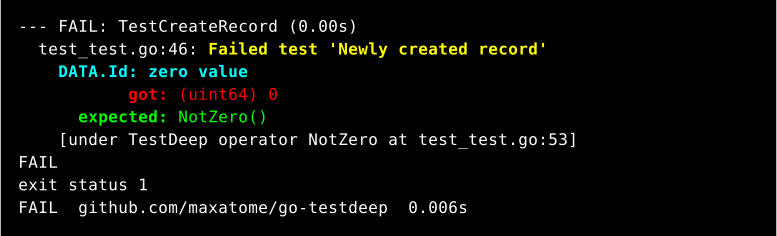
If CreateRecord() had not set correctly Id field, output would have
been:
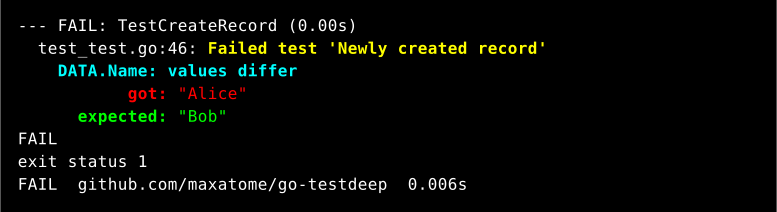
If CreateRecord() had set Name field to “Alice” value instead of
expected “Bob”, output would have been: